
Table Of Contents
Instances are lightweight copies of an object that do not contain any geometry data, but rather maintain a link to the original object. Because each instance only stores a limited amount of data – such as a transform matrix and sometimes material assignment information – they have several advantages over regular copies:
A scene with 1300 instances of a high resolution Buddha model (approximately 880,000 triangles per instance). Over a billion instanced triangles.
Redshift for Houdini can render instanced geometry using the powerful Redshift native instancing or point clouds features.
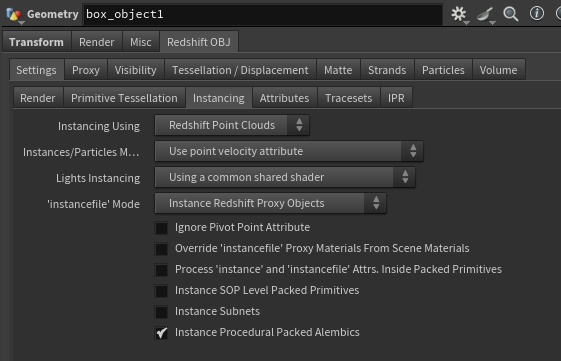
|
Controls whether it's using the instance object type or point clouds
When enabled the Pivot Point attribute is ignored which can be helpful for controlling instance placement.
When enabled, a material in the instance file can be overwritten with a directly applied material.
When enabled, Redshift uses the "instance" or "instancefile" point attributes to render instances inside packed objects. This requires the packed primitive to be expanded which can result in longer render times.
When enabled, packed primitives can be instanced at the SOP level, like when using a Copy SOP.
When enabled, it allows you to instance an entire subnet without the need to merge the object. Making it easier to instance complex objects with multiple parts.
When enabled this allows for the instancing of procedural packed alembics.
Note, the alembic procedural must still be installed properly and Procedural Alembics must first be enabled in the Redshift ROP. For more information, see the Alembic Procedural page.