
Globals - Live
Parallax Mapping
When enabled, depth is simulated for materials using displacement mapping without the need to generate additional polygons or subdivisions. The effect is similar to classic bump or normal mapping, but can appear even more realistic by simulating cast shadows.
This enables convincing effects like deep grooves between tiles or blades of grass on a lawn to be rendered in real time on otherwise flat geometry. Parallax Mapping heavily depends on the viewing angle, since no geometry is actually displaced the silhouette of an object remains unchanged but inner surface detail can benefit greatly.
Probes (Experimental)
When enabled, this option uses an experimental estimate of where the lighting relevant to the scene comes from. In some cases, this allows for more precise lighting with fewer passes. If in doubt, simply try it out and see whether you prefer the result with or without this option.
Color Management

|
Color Management in greater detail
For more information on the subject of color management please see the Color Management - OCIO ACES page.
OpenColorIO Configuration
This sets the path to the OpenColorIO config file to be used.
By default Redshift ships with and uses its own predefined configuration but a custom OCIO config be set here as well.
Rendering Color Space
This sets the linear color space that Redshift renders in, ACEScg by default which allows Redshift to make full use of its wider rendering color gamut.
Display
This is the Output Display Transform that should be set to a color space that is supported by the display that you are working on, for most people this will be sRGB.
View
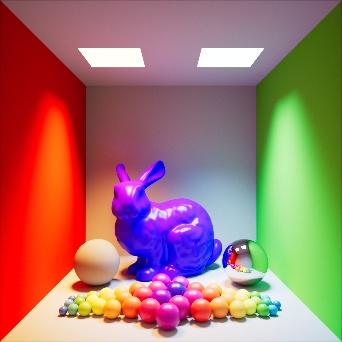
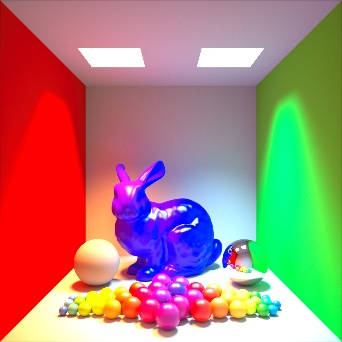
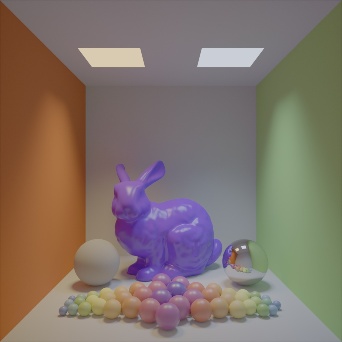
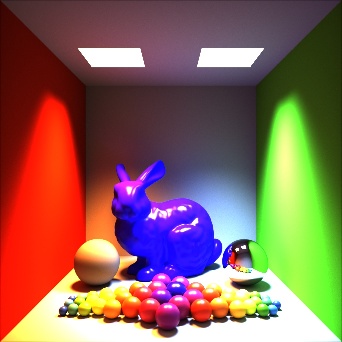
This determines how the image is displayed on screen and works in conjunction with the Display transform. By default this can be set to 4 different views, an ACES SDR tone-mapped result, un-tone-mapped, a logarithmic color space (ACEScct) or the raw linear result which is unaffected by the Display transform.
|
|
|
|
|
| View: ACES 1.0 SDR-Video | Un-tone-mapped | Log | Raw |
Use OpenColorIO File Rules
When enabled this will use any file rules established within the currently used OCIO config file. OCIO file rules are used to automatically set the correct color space for assets that fall within established parameters.
Examples:
- If a file is a jpg / png and has the words "albedo" or "diffuse" in the file name use the sRGB color space
- If a file is a jpg / png and has the words "roughness" or "normal" in the file name then use the Raw color space.
Options
Default Light
Enables or disables the rendering of any default lights in the respective digital content creation tool.
If your render appears brighter or differently lit than you expect this is a good option to check and disable.
Global Light Intensity
Scales the light intensity of all lights (except the Sun & Sky) in the scene up or down.