

Fresnel Dielectric
This page covers the Fresnel Dielectric node of the classic node materials in Cinema 4D. It computes the angle-dependent split between reflection and refraction on non-metals — the physical basis of glass, water and lacquer looks.
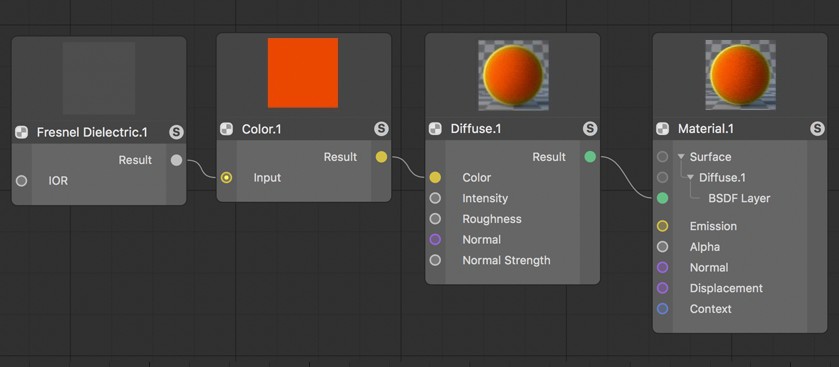 The Fresnel effect is already part of the BSDF Nodes in order to be able to simulate their reflection behavior for conductive and dielectric materials in a physically correct way. If you want to make other material properties, such as a color change, also dependent on the viewing angle on the surface, you can use the Fresnel Dielectric Node for this, which outputs a simple grayscale gradient.
This Node is only available when editing a classic Cinema 4D Node Material.
When light strikes a dielectric surface, some of the light will be refracted onto the object. The remaining part is reflected and will generate a reflection. This behavior, which depends on the viewing angle to the surface, can be described for many materials as a refractive index number value. Unlike the Fresnel Conductor Node, however, there is no coloring here; instead, only gray values will be output, whose brightness expresses how intense the specular properties are depending on the viewing angle.