

Settings
Input ports
Connect the object output port of the effector to be read out to the Effector input port.
Time is a time offset that can be fed in here and is simply added to the effector result when the output port of the same name is tapped.
The remaining input ports are self-explanatory and can largely be tapped from the identical output ports of the Data node:
Output ports
The parameters changed by the connected effector are output again at the output ports.
Worth mentioning here are Strength, the product of Strength (the one set in the effector), the decrease and the driving variable of the input value-controlled effector (see under How do Effectors work?) and Weight (the weighting is also multiplied here). These two ports are ideal for intervening in standard XPresso node graphs (see below). Example).
Global Matrix, Color, UV, Visibility and Time are the values changed by the effector and only lead to meaningful results if they have been fed with values at the input ports. Visibility is a Boolean value generated by the effector that returns 0 above a certain threshold value.
There are these output ports in total:
Example
Suppose you have a number of light sources and you want to control their intensities with a shader. No problem with the Effector Node:
- Create a Shader Effector in which you set a Noise shader in the 'Shading' tab under Custom Shader Channel and Shader.
- With such an XPresso setup, the intensities of the light sources can be controlled by the depicted shader:
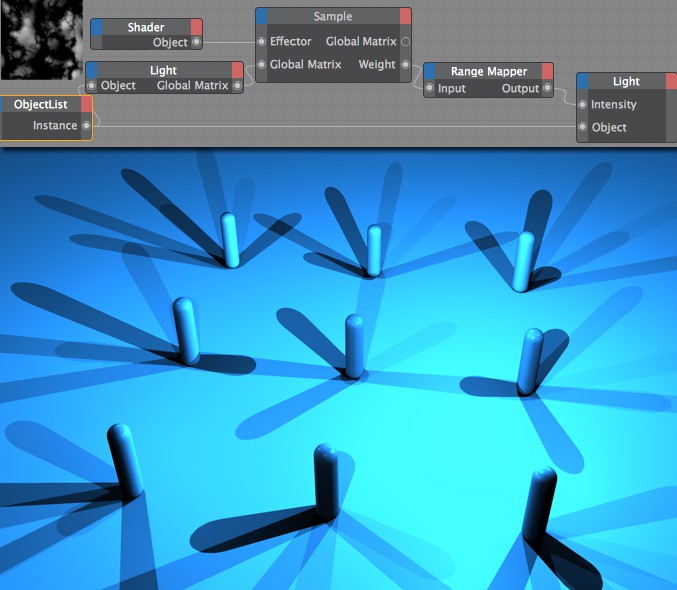

With the help of the Object List Node, to which all light sources are assigned, all global matrices of the light sources are successively fed to the Effector Node, which calculates a Weight value for each position, which in turn outputs meaningful intensities for light sources using a Range Mapper. Voilá: Intensity control using a shader. Almost all conceivable object parameters can be controlled in this way.